Top 3 Recommended Policies

A single cracked zirconia crown returned by a dissatisfied dentist. A milling machine that overheats and shuts down mid-production. A disgruntled employee who files a workplace injury claim. These aren't hypothetical scenarios for dental lab owners in New York: they're Tuesday. Running a dental laboratory in this state means operating under some of the strictest regulatory oversight and highest liability exposure in the country. Between the density of the metro market, sky-high commercial rents, and equipment that can cost more than a luxury car, the financial stakes are enormous. New York dental laboratory insurance isn't a line item you can afford to treat as an afterthought. It's the structural support holding your business together when something goes wrong. And in this industry, something always eventually goes wrong. The question isn't whether you'll face a claim, a compliance audit, or an equipment failure. It's whether you'll be financially prepared when it happens. This guide breaks down the specific coverages, state mandates, and emerging risks that New York lab owners need to understand right now, with practical detail that goes beyond generic advice.
Dental laboratories occupy a unique position in the
healthcare supply chain. You're
manufacturing medical devices, but you're not a hospital. You handle patient data, but you're not a
dentist's office. This gray area creates a
complex web of liability that many lab owners underestimate until a claim lands on their desk.
Common Industry Risks and Liabilities
The risks facing your lab fall into several distinct categories. Product liability tops the list: defective products account for over 40% of the total value of all liability claims across industries, and dental prosthetics are no exception. A poorly fitting crown, a bridge with material defects, or an allergic reaction to a metal alloy can all trigger lawsuits that name your lab directly.
Property damage is another constant concern. A fire in a lab full of flammable chemicals and expensive CAD/CAM equipment can wipe out hundreds of thousands of dollars in assets overnight. Slip-and-fall incidents involving delivery drivers or visiting clients create general liability exposure. Employee injuries from grinding equipment, chemical burns, or repetitive strain are common enough that workers' compensation claims should be expected, not feared.
Then there's the reputational risk. One botched case that goes viral in a dental professional forum can cost you accounts that took years to build.
State-Specific Regulatory Requirements
New York doesn't make it easy on lab owners. The state requires dental laboratories to register with the New York State Education Department, and compliance with infection control standards under the New York State Sanitary Code is mandatory. Labs must also meet FDA requirements as manufacturers of Class II medical devices.
From an insurance standpoint, New York mandates workers' compensation,
disability benefits, and paid family leave coverage for virtually all employers. There's no exception for small labs with just two or three technicians. The penalties for non-compliance are steep: the Workers' Compensation Board can issue
stop-work orders and fines of up to $2,000 per day for uninsured employers. That's not a risk worth taking.
Core Liability Coverage for Lab Operations
Liability insurance forms the backbone of any dental lab insurance portfolio. But not all liability policies are created equal, and the distinction between professional and general liability matters more than most lab owners realize.
Professional Liability and Errors & Omissions
Professional liability, often called errors and omissions (E&O), covers claims arising from the work you actually perform. If a crown you fabricated causes a patient injury, or if a shade mismatch leads to a costly redo and the dentist passes the bill to you, this is the policy that responds.
E&O claims in the dental lab space often involve allegations of negligence in fabrication, failure to follow dentist specifications, or use of substandard materials. The trend toward nuclear verdicts, with jury awards exceeding $10 million growing significantly in recent years, means that a $1 million policy limit that felt adequate five years ago may leave you dangerously exposed in 2026.
Most E&O policies for dental labs carry limits between $1 million and $5 million. Your ideal limit depends on your annual revenue, the volume of cases you produce, and the types of restorations you handle. Implant-supported work carries higher risk than simple denture repairs.
General Liability and Product Safety
General liability (GL) covers a different set of scenarios: bodily injury or property damage that occurs on your premises or results from your products after delivery. A dentist's assistant who trips over a box in your reception area, or a delivery driver injured in your parking lot, would fall under GL.
| Coverage Type | What It Covers | Typical Limits | Best For |
|---|---|---|---|
| General Liability | Third-party injuries, property damage on premises | $1M per occurrence / $2M aggregate | All labs |
| Professional Liability (E&O) | Fabrication errors, design defects, material failures | $1M-$5M per claim | All labs |
| Product Liability | Harm caused by delivered products | Often included in GL or E&O | Labs producing implant components |
Many insurers bundle GL and product liability together, but read the fine print. Some policies exclude claims related to products that have been "completed and delivered," which is precisely when most dental lab product claims arise.
Protecting Specialized Equipment and Physical Assets
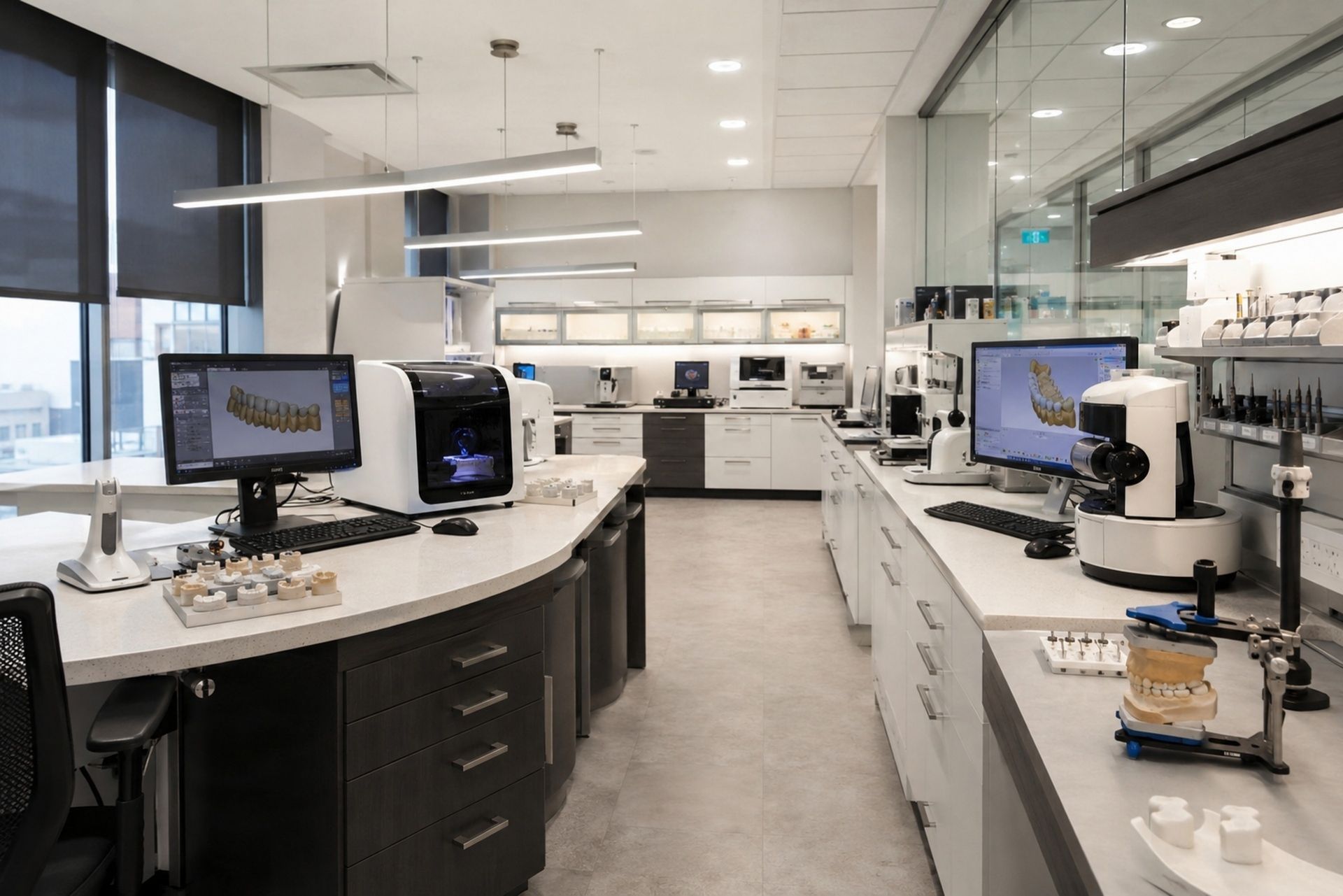
Your lab's physical assets represent a massive financial investment. A single Planmeca or Sirona milling unit can run $80,000 to $150,000. Protecting that investment requires more than a basic property policy.
Commercial Property and CAD/CAM Technology
Standard commercial property insurance covers your building (if you own it), equipment, inventory, and furnishings against perils like fire, theft, and certain natural disasters. But standard policies often cap coverage for specialized electronic equipment or exclude certain types of damage.
You'll want an inland marine or equipment floater policy specifically designed for high-value lab technology. These policies cover your CAD/CAM systems, 3D printers, sintering ovens, and digital scanners against a broader range of risks, including accidental damage and electrical surge. Given that a single lightning strike can fry $300,000 worth of digital equipment, this isn't optional.
Make sure your policy covers replacement cost, not actual cash value. A five-year-old milling machine might depreciate to $40,000 on paper, but replacing it with a comparable current model will cost you $120,000 or more.
Business Interruption and Supply Chain Loss
What happens when a burst pipe floods your lab and you can't produce cases for three weeks? Business interruption insurance covers your lost income and ongoing fixed expenses, like rent, loan payments, and employee salaries, during the downtime.
For New York labs specifically, this coverage is critical. Commercial rents in Manhattan, Brooklyn, and Queens often exceed $50 per square foot. Three weeks of downtime doesn't just mean lost revenue: it means paying $10,000 or more in rent for a space you can't use. A good business interruption policy also covers the cost of temporary relocation if your primary space becomes unusable.
Supply chain disruptions deserve attention too. If your zirconia supplier faces a shortage or a shipping delay forces you to miss deadlines, contingent business interruption coverage can help offset those losses.
New York's employee protection requirements are among the most demanding in the country. If you have even one employee, you're subject to multiple mandatory coverages.
Workers' Compensation and Disability Benefits
Workers' comp is non-negotiable in New York. Every employer must carry it, regardless of company size, number of employees, or whether those employees work part-time. Dental lab work involves real physical hazards: chemical exposure from acrylics and solvents, burns from casting equipment, and repetitive motion injuries from bench work.
Your workers' comp premiums depend on your payroll, claims history, and classification code. Dental labs typically fall under NCCI code 4902, which carries moderate rates. But a single serious claim can spike your experience modification rate and increase premiums for years.
New York also requires statutory disability benefits (DBL) insurance, which provides partial wage replacement for employees who become disabled off the job. This is separate from workers' comp and must be carried through an approved carrier or through a self-insurance plan approved by the state.
Paid Family Leave Compliance
Since 2018, New York has required paid family leave (PFL) coverage for most employees. As of 2026, eligible employees can take up to 12 weeks of paid leave at 67% of their average weekly wage, capped at 67% of the state average weekly wage. This coverage is funded through employee payroll deductions, but you as the employer are responsible for obtaining and maintaining the policy.
The PFL and DBL policies are often bundled together through the same carrier. Failing to provide PFL coverage exposes you to penalties and potential lawsuits from employees denied their benefits.
Emerging Threats: Cyber Liability and Data Privacy
Digital workflows have transformed dental lab operations. They've also introduced a category of risk that didn't exist a decade ago.
Securing Patient Health Information (PHI)
If your lab receives digital impressions, patient names, or any other protected health information from dental offices, you're likely considered a business associate under HIPAA. That means you have a legal obligation to protect that data, and a breach can result in fines ranging from $100 to $50,000 per violation, with an annual maximum of $1.5 million per violation category.
Cyber liability insurance covers the costs associated with a data breach: forensic investigation, notification of affected individuals, credit monitoring services, legal defense, and regulatory fines. It also covers ransomware attacks, which have increasingly targeted small healthcare-adjacent businesses that lack dedicated IT security teams.
A basic cyber policy for a dental lab typically costs between $1,000 and $3,000 annually, depending on your revenue and the volume of PHI you handle. That's a modest price for coverage that could save you from a six-figure breach response.
Strategic Implementation of a Comprehensive Insurance Portfolio
Building the right insurance program for your dental lab isn't about buying every policy available. It's about understanding where your specific vulnerabilities lie and matching coverage to those risks. A two-person lab doing removable prosthetics has a very different risk profile than a 15-person operation milling implant abutments and handling digital workflows.
Start by conducting an honest risk assessment. What equipment would cripple your production if it failed? How much PHI flows through your systems? What's your annual case volume, and what percentage involves high-liability work like implants? The answers shape your coverage priorities.
Work with a broker who understands both dental lab operations and New York's regulatory environment. Generic business insurance agents often miss critical coverages or recommend limits that are too low for the state's litigation climate. Ask about package policies designed for dental labs, which can bundle GL, property, E&O, and equipment coverage at lower combined premiums than purchasing each separately.
Review your policies annually. Your lab's risk profile changes as you add equipment, hire staff, or expand into new service areas like 3D printing. A policy that fit your business two years ago may have dangerous gaps today. The investment in proper dental laboratory insurance in New York isn't just about protecting against worst-case scenarios. It's about building a foundation stable enough to let you focus on growth instead of worry.
Frequently Asked Questions
How much does insurance typically cost for a dental lab in New York? Costs vary widely based on lab size, revenue, and coverages selected. A small lab might pay $3,000 to $7,000 annually for a basic package, while larger operations with extensive equipment and higher payrolls can exceed $15,000 to $25,000.
Do I need insurance if I'm a sole proprietor with no employees? You're not required to carry workers' comp or PFL as a sole proprietor with no employees, but you still need general liability and professional liability to protect against client claims and product defects.
Is cyber insurance really necessary for a dental lab? Yes, if you receive any patient data digitally. Even a small breach involving a few hundred patient records can trigger notification requirements and fines that far exceed the cost of a cyber policy.
Can I bundle all my coverages into one policy? Many insurers offer business owner's policies (BOPs) that combine GL, property, and business interruption coverage. You'll typically need separate policies for workers' comp, cyber liability, and professional liability.
What happens if I operate without workers' comp in New York? The state can issue stop-work orders, impose fines of up to $2,000 per day, and hold you personally liable for any employee injury costs. It's one of the most aggressively enforced mandates in the state.

ABOUT THE AUTHOR:
TAYLOR RICHARDSON
Taylor Richardson is the founder and CEO of 5M Insurance. With a focus on real estate risk management, Taylor helps investors and property managers nationwide secure smarter, scalable coverage solutions—without the headaches of traditional insurance brokers.
Contact Us
Comprehensive Coverage for Businesses of All Sizes
Protecting Your Business, Securing Your Future
General Liability Insurance
Protection against lawsuits and third-party claims.

Workers Comp Insurance
Required protection for employees in case of injury or illness.
Commercial Property Insurance
Coverage for buildings, equipment, and business assets.
Commercial Auto Insurance
Coverage for company vehicles and fleet operations.
Commercial Umbrella Insurance
Protection against errors, omissions, and negligence claims.
Business Owner's Policy
A bundled policy combining essential business coverages.
Personalized Insurance for Every Stage of Life
Protect What Matters Most with Comprehensive Coverage
Jewelry Insurance
Specialized protection for valuable items like engagement rings, watches, and heirlooms.
Pet Insurance
Financial protection for veterinary care and unexpected pet health expenses.
Specialized Insurance for Your Business Needs
Serving the Industries That Drive
New York & New Jersey






What Our Clients Say
Trusted by Businesses & Families Across New York & New Jersey
Frequently Asked Questions
Get Answers to Your Insurance Questions
We understand that insurance can be complex. Here are answers to some of the most common questions our clients ask. If you need more information, our team is always here to help.
- Still have questions?
How do I know what coverage I need?
Choosing the right insurance starts with understanding your risks. For personal insurance, consider factors like your home’s value, your vehicle, and your financial responsibilities. Homeowners may need additional protection for floods or valuable belongings, while drivers should evaluate coverage limits based on their assets.
For businesses, the right coverage depends on the industry, number of employees, and liability risks. General liability is essential for most businesses, but some may need property, workers’ compensation, or business owner’s policies. Our team can assess your needs and guide you to the best options.
What factors affect my insurance rate?
Insurance rates are influenced by multiple factors. For auto policies, your driving history, vehicle type, and location play a major role. Home insurance costs depend on your home’s value, construction type, and potential risks like flooding or fire hazards.
For business insurance, rates vary based on the industry, size, claims history, and coverage limits. High-risk industries may require specialized policies, while businesses with strong safety measures and claims-free histories can qualify for better rates. Our agents help find discounts and cost-saving opportunities.
Why should I work with an independent insurance agency?
Unlike captive agents who represent a single insurance company, independent agencies like Joyce Insurance Agency work with multiple carriers to find the best coverage for your needs. This means you get more choices, competitive rates, and a policy that truly fits your situation.
We take the time to understand your needs, compare options, and provide expert advice. Whether you're insuring your home, car, or business, our priority is finding you the best protection at a great value.
How quickly can I get insured?
The time it takes to secure a policy depends on the type of insurance. Auto and home policies can often be issued the same day, while business insurance may take longer, especially for specialized coverage. Workers’ compensation and commercial policies may require underwriting approval, which can extend the timeline.
We prioritize efficiency and make the process as smooth as possible. Once we understand your needs, we work quickly to get you insured with minimal hassle.
What should I do if I need to file a claim?
If you need to file a claim, contact us as soon as possible. We’ll guide you through the process and ensure you have everything needed to submit your claim correctly. Gathering necessary documentation, such as photos, receipts, or witness statements, can help speed up the process.
We work directly with your insurance provider to streamline communication and advocate on your behalf. Our goal is to make sure your claim is handled quickly and fairly so you can recover without unnecessary stress.
How can I lower my insurance costs?
There are several ways to reduce insurance premiums without sacrificing coverage. For auto insurance, maintaining a clean driving record, bundling policies, and increasing deductibles can help lower costs. Homeowners can save by installing security systems, upgrading safety features, and bundling home and auto policies.
For business owners, implementing risk management strategies, maintaining a claims-free history, and working with an independent agent to find competitive rates can lead to cost savings. Our team helps you explore discounts and options to ensure you’re getting the best value.
Contact Us
Phone
Location