A single zirconia crown can take your lab 8 to 12 hours to fabricate, cost $150 or more in materials and labor, and shatter in the back of a courier van before it ever reaches the dentist's chair. That scenario plays out more often than most lab owners expect. Inland marine insurance for dental labs addresses exactly this kind of risk: protecting high-value restorations, prosthetics, and equipment while they're moving between locations. It's a coverage type that most small lab owners don't hear about until after they've eaten the cost of a damaged shipment. The name "inland marine" sounds like it belongs on a
cargo ship, but it actually covers goods in transit over land, plus
specialized equipment that moves between sites. For dental labs shipping cases daily through couriers, the mail, or their own delivery drivers, this coverage fills a gap that standard business policies almost always miss. Whether you're dealing with shipping damage, customer disputes over lost work, transit limits, valuation disagreements, or the claims process itself, getting the details right matters. Your margins are already tight. One uninsured loss can wipe out a week's revenue.
Why Dental Labs Need Specialized Inland Marine Insurance
Dental labs operate differently from most small businesses. Your finished product leaves your physical control every single day, often multiple times. That constant movement of valuable goods creates a risk profile that generic business insurance wasn't designed to handle. Most lab owners carry general liability and maybe a commercial property policy, assuming those will cover any losses. They won't, and discovering that gap after a $3,000 implant bridge goes missing is an expensive lesson.
The Risk of High-Value Restorations in Transit
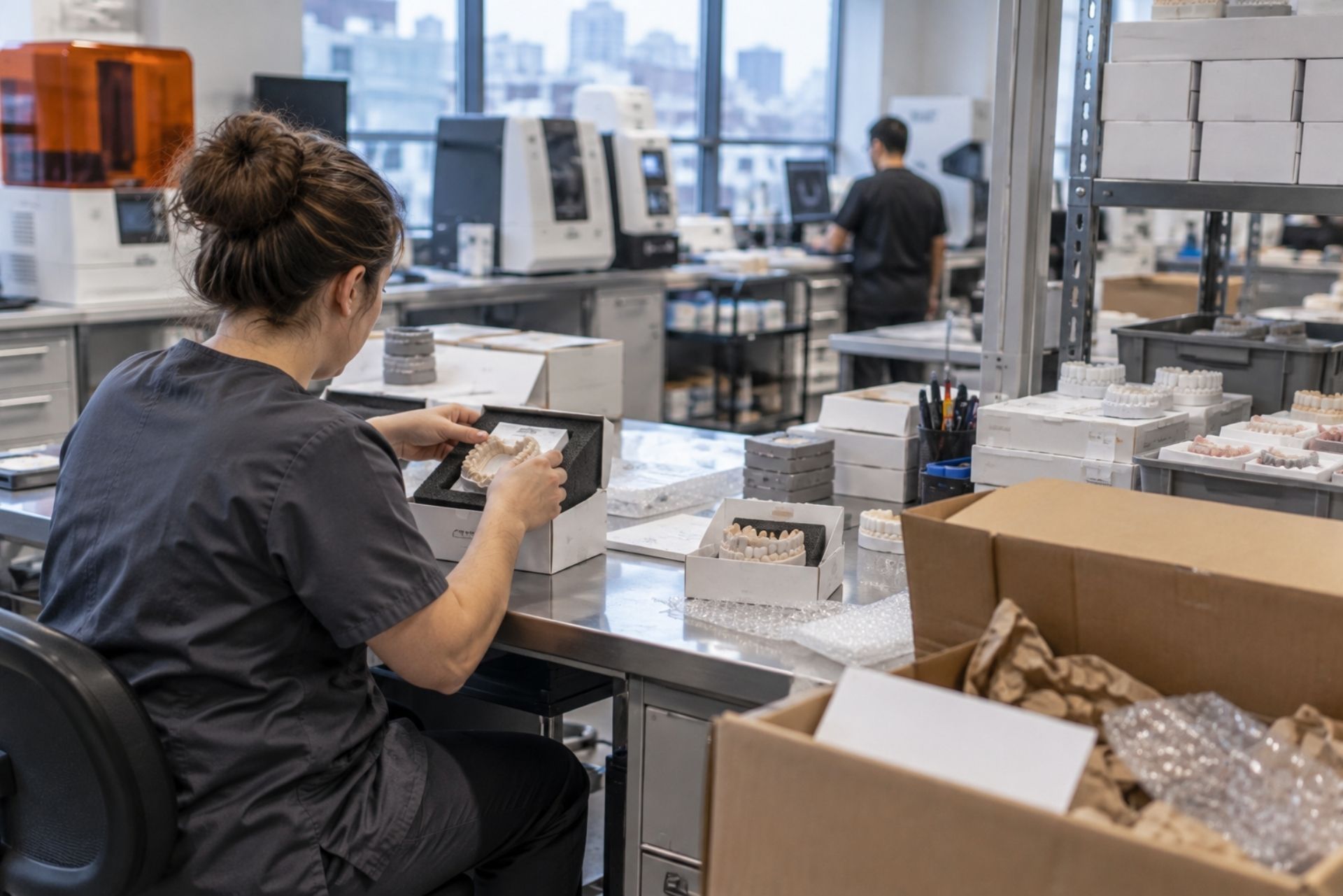
Consider what your lab ships on a typical Monday. A full-arch implant case worth $4,000. Three PFM crowns at $200 each. A set of dentures. A removable partial. The total value sitting in a courier's vehicle might exceed $6,000 before lunch. These items are fragile, custom-made, and irreplaceable without starting from scratch. A single hard brake or a dropped package can crack porcelain, chip zirconia, or bend metal frameworks beyond repair. The financial exposure compounds quickly because you're not just losing the materials: you're losing the labor hours, the kiln time, and the trust of the dentist who needed that case for a patient appointment tomorrow morning.
Why General Liability and Property Policies Often Fall Short
General liability covers injuries and property damage you cause to others. Commercial property covers your stuff while it's at your location. Neither one reliably covers goods in transit. Some property policies include a small transit extension, but limits are often capped at $1,000 or $2,500: far below the value of a typical day's shipments. Even if your policy has a transit endorsement, it may exclude damage caused by the carrier or require proof that loss occurred at a specific point during shipping. Inland marine policies are purpose-built for goods that move. They cover your products from the moment they leave your bench until they arrive at the
dental office, and often on the return trip too.

Understanding Transit Limits and Valuation Methods
Getting the right inland marine policy isn't just about having one. It's about making sure your limits and valuation terms actually match the value of what you're shipping. Too many lab owners buy a policy with a $2,500 per-shipment cap and don't realize they regularly send out cases worth twice that.
Setting Per-Package and Per-Vehicle Limits
Most inland marine policies for dental labs set two key limits. The per-package limit caps what you can recover for any single shipment or case. The per-vehicle or per-occurrence limit caps the total payout if an entire delivery vehicle is involved in an accident or theft. If your driver carries 15 cases in a van and gets into a wreck, the per-vehicle limit is what matters. You should audit your shipping logs quarterly. Look at your highest-value single case from the past 90 days and your busiest delivery run. Set your per-package limit above the first number and your per-vehicle limit above the second. Small business inland marine premiums average around $48 per month in 2026, with higher coverage benchmarks running roughly $80 monthly. That's a modest cost relative to the exposure.
Replacement Cost vs. Actual Cash Value in Lab Claims
Valuation method determines how much you actually receive when you file a claim. Replacement cost pays what it takes to remake the item from scratch: materials, labor, and overhead. Actual cash value (ACV) deducts depreciation, which doesn't make much sense for a custom dental restoration that was brand new when it shipped. Always push for replacement cost valuation. ACV might reduce your premium slightly, but a crown doesn't depreciate like a used car. If your policy uses ACV, you could file a claim on a $400 crown and receive $150 after the insurer applies depreciation formulas. That's not a gap you want to discover mid-claim.
Comparison: Standard Carrier Liability vs. Inland Marine Coverage
Most lab owners assume their shipping carrier covers damage in transit. Carriers do accept some liability, but the limits are often shockingly low and the claims process is adversarial.
| Feature | Standard Carrier Liability | Inland Marine Policy |
|---|---|---|
| Coverage trigger | Carrier must be proven at fault | Covers most causes of loss |
| Typical limit | $100 or less per package (USPS, FedEx) | $5,000-$50,000+ per occurrence |
| Valuation | Declared value, often capped | Replacement cost available |
| Claims timeline | 30-120 days, often denied | Typically 15-45 days |
| Theft coverage | Limited or excluded | Usually included |
| Breakage from poor packing | Often denied | Covered if packing meets policy terms |
FedEx and UPS both cap their default liability at $100 per package unless you purchase declared value coverage at the time of shipping. Even then, you'll need to prove the carrier caused the damage, which can be difficult with fragile dental restorations. An inland marine policy puts you in control of your own coverage rather than relying on a carrier's willingness to pay.
Common Shipping Damage Scenarios and Customer Cases
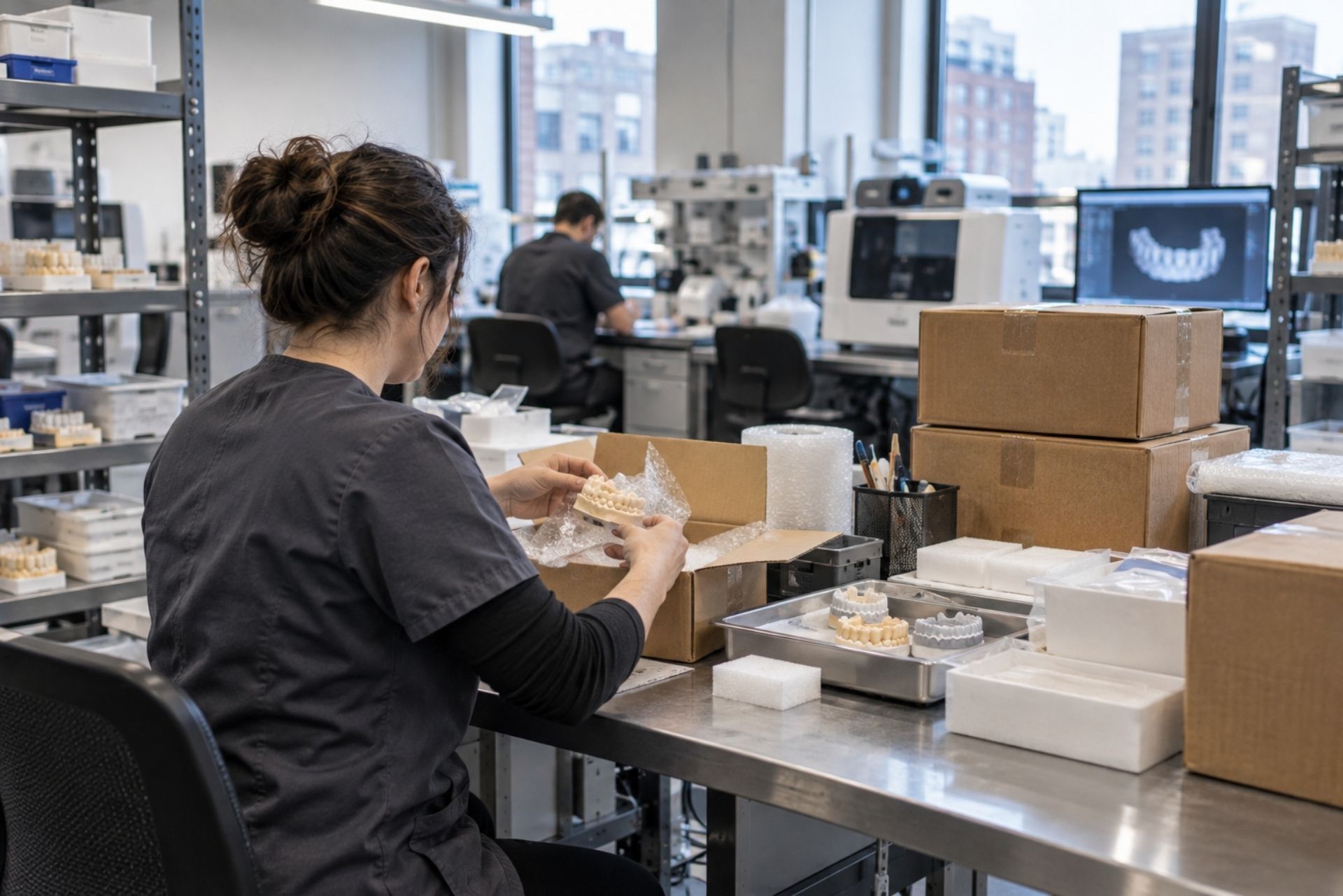
Real claims from dental labs tend to follow a few predictable patterns. Knowing these scenarios helps you understand what your policy needs to cover and how to prevent losses in the first place.
Damage During Third-Party Courier Transit
The most frequent claim type involves porcelain fractures during courier delivery. A lab in Ohio shipped a six-unit porcelain bridge via a regional courier service. The case arrived with two units cracked through the connector. The courier denied responsibility, citing "inadequate packaging." The lab's inland marine policy covered the full $2,400 replacement cost because the policy didn't include a packaging exclusion tied to the courier's subjective assessment. This is a common dispute: carriers love to blame packaging. Your policy language around packing requirements matters enormously. Some policies require you to follow specific packing standards, while others are more flexible. Read that section carefully before you buy.
Theft and Misplacement of Finished Prosthetics
Lost packages are the second most common issue. A finished implant case worth $5,500 simply never arrived at the dental office. The tracking showed "delivered," but the office never received it. The carrier's investigation took 60 days and ultimately denied the claim because the tracking confirmed delivery. The lab's inland marine insurer paid the claim within three weeks based on the dentist's written confirmation that the package was never received. Theft from delivery vehicles, porch piracy at dental offices, and misrouted packages all fall into this category. Without your own transit coverage, you're stuck arguing with a carrier that has every incentive to deny your claim.
The Claims Process: Moving from Damage to Reimbursement
Filing a dental lab transit claim isn't complicated, but sloppy documentation is the number one reason claims get reduced or denied. The process typically follows four steps: report the loss, document everything, submit your claim with proof of value, and wait for the adjuster's decision.
You should report damage or loss to your insurer within 24 to 48 hours. Most policies require prompt notification, and delays can give the insurer grounds to question the claim. Don't throw away damaged items or packaging until the insurer tells you to: they may want to inspect them or send a photo request.
Documenting Loss and Proof of Value
Your claim lives or dies on documentation. For every case that leaves your lab, you should have a work order showing the materials used, the labor time, and the total value. Photographs of the finished restoration before shipping are extremely helpful. If you're using digital workflows with CAD/CAM, save the design files: they prove exactly what was fabricated. Keep shipping receipts and tracking numbers organized by date. When damage occurs, photograph the packaging and the damaged item from multiple angles before touching anything. A dentist's written statement confirming the item arrived damaged or didn't arrive at all strengthens your claim significantly. Labs that maintain these records recover their full claim amount far more consistently than those scrambling to reconstruct details after the fact.
Frequently Asked Questions About Dental Lab Shipping Insurance
Does my dental lab's general liability policy cover items I ship to dentists? No. General liability covers bodily injury or property damage you cause to third parties. It doesn't cover your own products damaged during shipping. You need a separate inland marine policy or a transit endorsement for that.
How much does inland marine insurance cost for a small dental lab? Premiums for small businesses typically start around $48 per month, though labs with higher shipment values or volumes may pay closer to $80 monthly. Your specific rate depends on your coverage limits, deductible, and claims history.
Can I just buy declared value coverage from FedEx or UPS instead? You can, but it's limited. Carrier declared value typically caps at a few thousand dollars, requires you to prove the carrier was at fault, and often excludes fragile items or "insufficient packaging." An inland marine policy gives you broader, more reliable protection.
What's the typical deductible on a dental lab inland marine policy? Deductibles range from $250 to $1,000 for most small lab policies. Lower deductibles mean higher premiums. If most of your cases are worth $300 to $500, a $500 deductible might not make sense: you'd rarely exceed it on a single-case claim.
Does inland marine cover my equipment if I take it to a dental office for a shade match? Yes, most policies cover portable equipment like shade guides, digital scanners, and other tools you transport to client locations. Confirm this with your insurer, as some policies distinguish between goods in transit and mobile equipment.
Are returns from the dentist's office back to my lab covered? Most inland marine policies cover two-way transit, but not all do. Check whether your policy covers "outbound and inbound" shipments or only one direction. If a dentist sends back a case for adjustments and it's damaged in return transit, you want that covered.
Making the Right Choice for Your Lab's Logistics
Protecting your dental lab's work in transit isn't optional if you're shipping cases daily. The cost of a single uninsured loss: a full-arch case, an implant bar, even a handful of crowns: can dwarf a full year's premium for an inland marine policy. Start by auditing your shipment values. Pull your last three months of invoices and identify your highest single-case value and your peak daily shipping total. Those numbers set your minimum per-package and per-occurrence limits.
Talk to an insurance agent who understands dental lab operations, not just general small business coverage. Ask specifically about replacement cost valuation, packaging requirements, two-way transit coverage, and how the claims process works before you need it. The right inland marine coverage for your dental lab turns a potential business crisis into a manageable inconvenience. Your craftsmanship deserves protection that doesn't end at your front door.
ABOUT THE AUTHOR:
TAYLOR RICHARDSON
Taylor Richardson is the founder and CEO of 5M Insurance. With a focus on real estate risk management, Taylor helps investors and property managers nationwide secure smarter, scalable coverage solutions—without the headaches of traditional insurance brokers.
Contact Us
Comprehensive Coverage for Businesses of All Sizes
Protecting Your Business, Securing Your Future
General Liability Insurance
Protection against lawsuits and third-party claims.

Workers Comp Insurance
Required protection for employees in case of injury or illness.
Commercial Property Insurance
Coverage for buildings, equipment, and business assets.
Commercial Auto Insurance
Coverage for company vehicles and fleet operations.
Commercial Umbrella Insurance
Protection against errors, omissions, and negligence claims.
Business Owner's Policy
A bundled policy combining essential business coverages.
Personalized Insurance for Every Stage of Life
Protect What Matters Most with Comprehensive Coverage
Jewelry Insurance
Specialized protection for valuable items like engagement rings, watches, and heirlooms.
Pet Insurance
Financial protection for veterinary care and unexpected pet health expenses.
Specialized Insurance for Your Business Needs
Serving the Industries That Drive
New York & New Jersey





What Our Clients Say
Trusted by Businesses & Families Across New York & New Jersey
Frequently Asked Questions
Get Answers to Your Insurance Questions
We understand that insurance can be complex. Here are answers to some of the most common questions our clients ask. If you need more information, our team is always here to help.
- Still have questions?
How do I know what coverage I need?
Choosing the right insurance starts with understanding your risks. For personal insurance, consider factors like your home’s value, your vehicle, and your financial responsibilities. Homeowners may need additional protection for floods or valuable belongings, while drivers should evaluate coverage limits based on their assets.
For businesses, the right coverage depends on the industry, number of employees, and liability risks. General liability is essential for most businesses, but some may need property, workers’ compensation, or business owner’s policies. Our team can assess your needs and guide you to the best options.
What factors affect my insurance rate?
Insurance rates are influenced by multiple factors. For auto policies, your driving history, vehicle type, and location play a major role. Home insurance costs depend on your home’s value, construction type, and potential risks like flooding or fire hazards.
For business insurance, rates vary based on the industry, size, claims history, and coverage limits. High-risk industries may require specialized policies, while businesses with strong safety measures and claims-free histories can qualify for better rates. Our agents help find discounts and cost-saving opportunities.
Why should I work with an independent insurance agency?
Unlike captive agents who represent a single insurance company, independent agencies like Joyce Insurance Agency work with multiple carriers to find the best coverage for your needs. This means you get more choices, competitive rates, and a policy that truly fits your situation.
We take the time to understand your needs, compare options, and provide expert advice. Whether you're insuring your home, car, or business, our priority is finding you the best protection at a great value.
How quickly can I get insured?
The time it takes to secure a policy depends on the type of insurance. Auto and home policies can often be issued the same day, while business insurance may take longer, especially for specialized coverage. Workers’ compensation and commercial policies may require underwriting approval, which can extend the timeline.
We prioritize efficiency and make the process as smooth as possible. Once we understand your needs, we work quickly to get you insured with minimal hassle.
What should I do if I need to file a claim?
If you need to file a claim, contact us as soon as possible. We’ll guide you through the process and ensure you have everything needed to submit your claim correctly. Gathering necessary documentation, such as photos, receipts, or witness statements, can help speed up the process.
We work directly with your insurance provider to streamline communication and advocate on your behalf. Our goal is to make sure your claim is handled quickly and fairly so you can recover without unnecessary stress.
How can I lower my insurance costs?
There are several ways to reduce insurance premiums without sacrificing coverage. For auto insurance, maintaining a clean driving record, bundling policies, and increasing deductibles can help lower costs. Homeowners can save by installing security systems, upgrading safety features, and bundling home and auto policies.
For business owners, implementing risk management strategies, maintaining a claims-free history, and working with an independent agent to find competitive rates can lead to cost savings. Our team helps you explore discounts and options to ensure you’re getting the best value.
Contact Us
Phone
Location