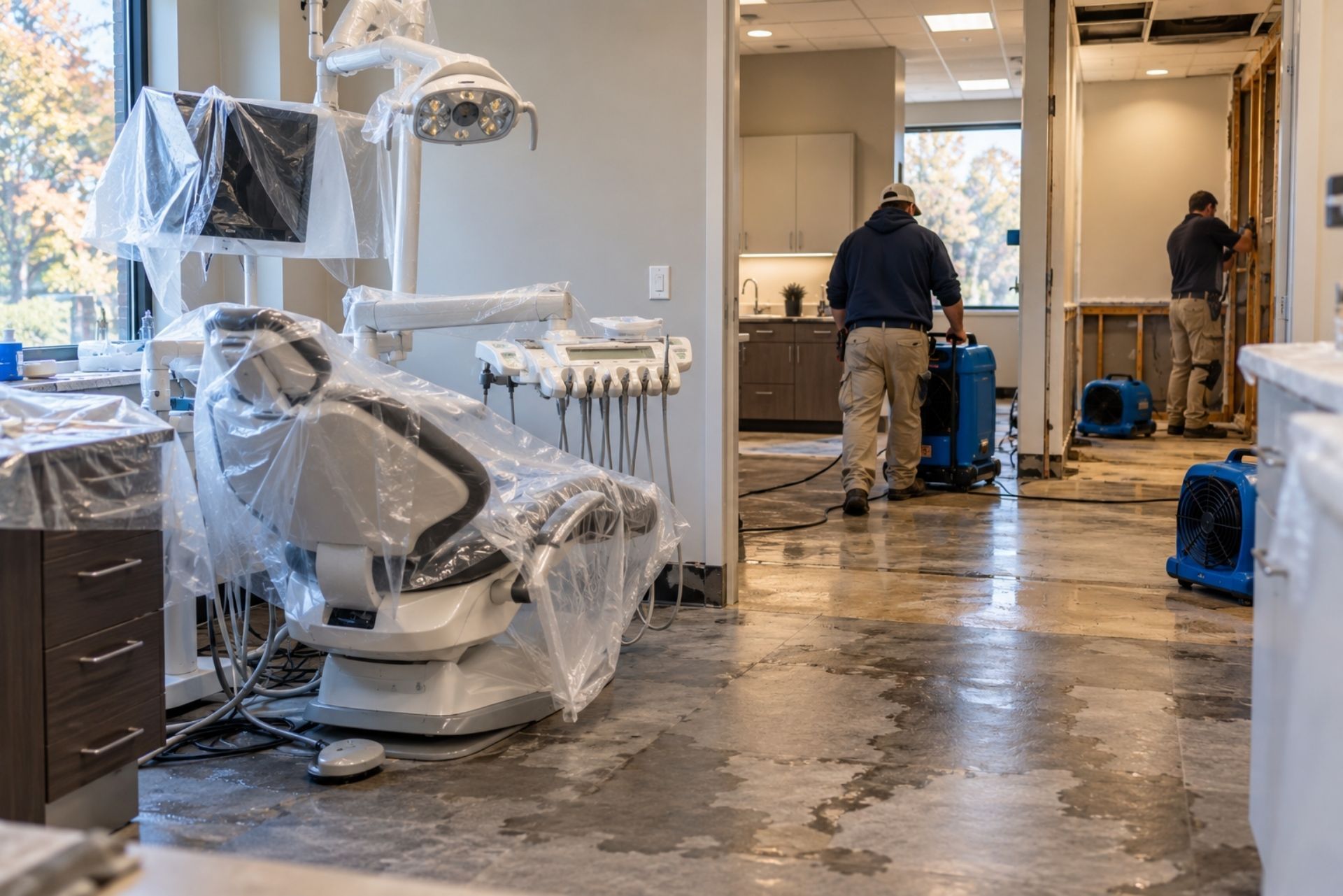
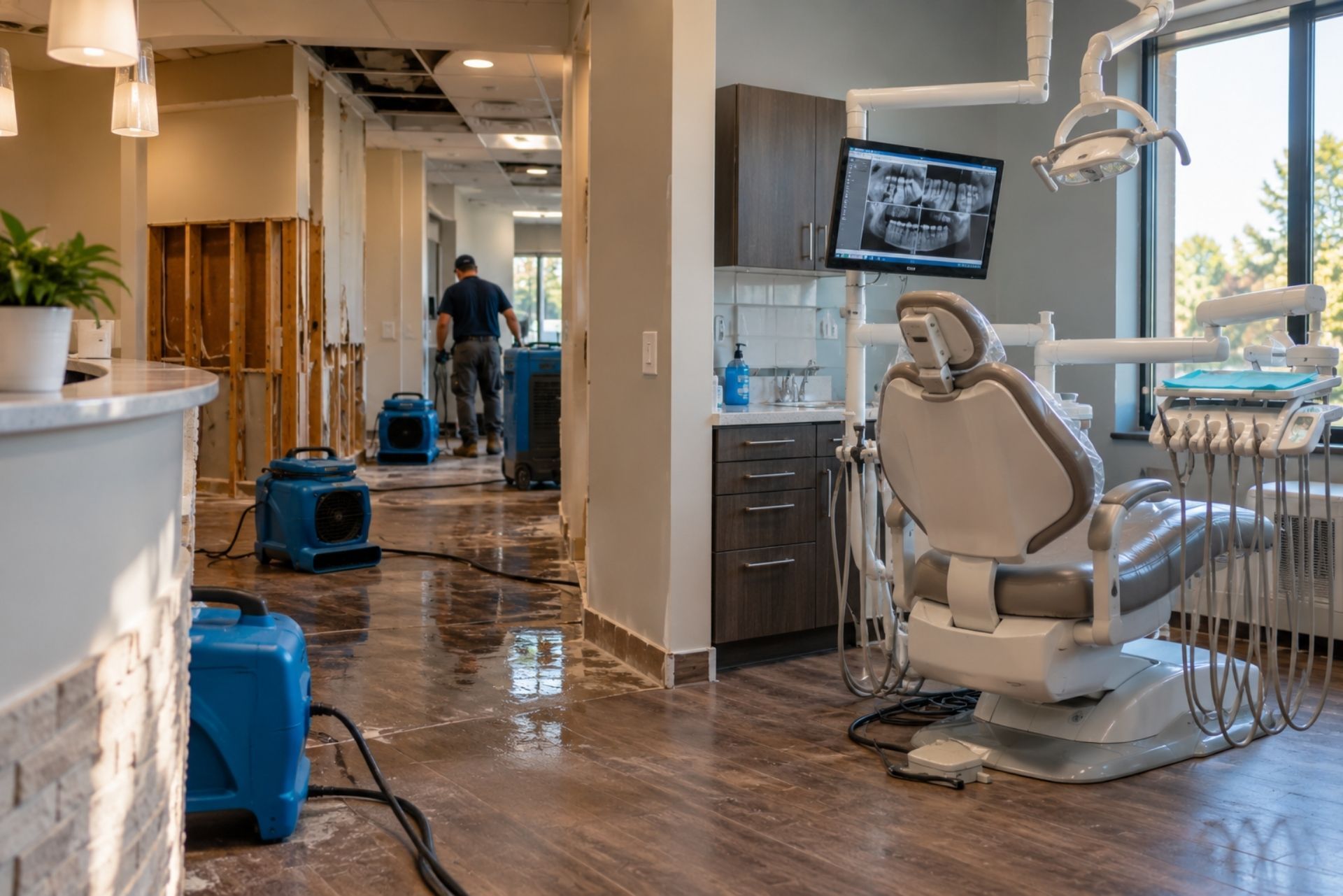
A burst pipe floods your operatory on a Friday night. By Monday morning, you're staring at warped cabinetry, a waterlogged digital X-ray sensor, and a week's worth of cancelled appointments. Your
property insurance might cover the physical damage, but who's paying the lost production, your hygienist's salary, and the temporary space you need to keep seeing patients? That's exactly where business income insurance steps in for dental practices. This coverage addresses the financial fallout from water damage, equipment failure, payroll obligations, extra expenses, and the full restoration timeline. With dental practices facing what's been called a
fiscal squeeze of rising expenses outpacing revenue, the gap between a covered property loss and actual financial recovery can sink a practice. Understanding how this coverage works isn't optional anymore: it's a survival skill for practice owners.
Why Dental Practices Need Business Income Coverage
Most dentists carry property insurance and general liability. Those policies handle the tangible stuff: the broken equipment, the damaged walls, the slip-and-fall in the parking lot. But they don't touch the income you lose while your doors are shut.
Dental practices are uniquely vulnerable to income disruption. You can't stockpile procedures the way a retailer stockpiles inventory. Every day your chairs sit empty, that production is gone forever. A two-week shutdown during your busiest season could mean significant lost collections depending on your practice size, and your fixed costs don't pause just because your handpieces do.
Protection Against Physical Property Damage
Water damage has become the primary driver of property-related business interruptions in 2026, and dental offices are prime targets. Practices rely on plumbing for operatory sinks, sterilization equipment, and building HVAC systems. A single supply line failure behind a wall can go undetected for hours, soaking through drywall, subfloors, and into expensive imaging equipment below.
Equipment failure presents its own risks. Digital panoramic units, CBCT scanners, and CAD/CAM milling machines represent six-figure investments. When a compressor dies or an autoclave fails catastrophically, the replacement timeline isn't measured in days: it's measured in weeks. The cost of dental equipment and supplies has increased by 6% over the past year, making both replacement and temporary rental more expensive than ever.
Covering Fixed Expenses During a Shutdown
Your lease payment doesn't care that your office is under construction. Neither does your student loan servicer, your malpractice carrier, or your front desk team. Typical fixed monthly obligations for a dental practice include loan payments that can average $3,200 for SBA loans alone, plus roughly $800 in malpractice premiums, staff salaries, software subscriptions, and equipment leases.
Business income coverage picks up these costs during the restoration period so you're not draining personal savings or taking on emergency debt. Without it, you're essentially self-insuring against every possible disruption, which is a bet most practice owners can't afford to lose.

What Business Income Insurance Actually Pays For
The name "business income insurance" sounds straightforward, but the actual mechanics matter. Your policy calculates what you would have earned had the loss never happened, then pays the difference between that projection and your actual earnings during the shutdown. Three main categories of payment come into play.
Replacing Lost Net Income
This is the core benefit. Your insurer looks at your historical production and collection data, adjusts for seasonal trends, and estimates what you would have collected during the period your office was closed or operating at reduced capacity. If your practice typically collects $80,000 per month and you're shut down for three weeks, the lost net income portion covers the profit you would have taken home after normal operating expenses.
One nuance that catches dentists off guard: the policy pays based on what you would have earned, not what you billed. If your collection rate runs 92%, the insurer uses that figure, not your gross production. Keep clean financial records. Practices with sloppy bookkeeping face longer claim disputes and smaller payouts.
Ongoing Operating Costs and Payroll
Staff retention is critical during a shutdown. Losing a trained hygienist or experienced treatment coordinator because you couldn't make payroll for three weeks costs far more in the long run than their salary during the closure. Business income policies typically cover continuing payroll for key employees, though some policies require a specific endorsement for full staff coverage.
Other ongoing costs that qualify include rent or mortgage payments, insurance premiums, accounting fees, phone and internet service, and equipment lease payments. The policy essentially keeps your practice financially alive while the physical space gets repaired.
Extra Expenses to Minimize Downtime
Here's where dental-specific needs really show up. Extra expense coverage pays for costs above your normal operating expenses that help you resume operations faster or maintain some level of production during repairs. Common examples include renting temporary operatory space, expedited shipping for replacement equipment, after-hours contractor fees to speed up restoration, and the cost of redirecting patients to a temporary location.
This coverage often saves more than it costs. If spending $5,000 on expedited equipment shipping gets you open five days sooner, you've recovered production that would have otherwise been lost. According to the Morgano Agency, extra expense coverage allows a practice to spend money to minimize a shutdown, potentially recovering significantly more in production revenue than the cost of the expense.
Not all business income policies are created equal. Standard commercial property policies include a basic business income provision, but dental practices often need endorsements or specialized riders to close coverage gaps.
Comparison Table: Standard vs. Specialized Dental Endorsements
| Feature | Standard BOP Coverage | Dental-Specific Endorsement |
|---|---|---|
| Lost income calculation | Based on general revenue history | Accounts for seasonal patient volume and procedure mix |
| Equipment breakdown | Often excluded; requires separate rider | Typically included for dental-specific equipment |
| Payroll coverage | May cover only key employees | Can extend to full staff including hygienists and assistants |
| Extra expense limit | Usually capped at a flat dollar amount | Higher limits reflecting dental temporary-space costs |
| Restoration period | Standard 12 months | Can extend to 18 months for specialty equipment lead times |
| Waiting period | 72 hours typical | Some policies offer 24-hour triggers |
| Utility service disruption | Rarely included | Available as add-on for power and water outages |
The waiting period deserves special attention. A 72-hour waiting period means you absorb the first three days of lost income yourself. For a practice producing $4,000 per day, that's $12,000 out of pocket before coverage kicks in, according to the Morgano Agency. Policies with shorter waiting periods cost more in premium but can be worth every dollar.
Key Policy Terms Every Dentist Should Know
Insurance policies are written by lawyers, not dentists. A few terms show up repeatedly in claims disputes, and understanding them before you file a claim makes a real difference.
The Restoration Period Explained
The restoration period is the window during which your business income coverage applies. It starts when the physical damage occurs and ends when your property should be repaired with reasonable speed, using similar quality materials. The key word is "should." If your contractor drags their feet, the insurer won't keep paying indefinitely.
For dental offices, the restoration timeline gets complicated by equipment lead times. A replacement panoramic X-ray unit might take 8 to 12 weeks to manufacture and install, as the total timeline including custom configuration and site preparation typically extends to this range according to GCMM Dental Construction. Insurance carriers have been extending payment wait times to three to eight weeks for claim processing itself, which means you could be waiting months before everything is resolved. Make sure your policy's restoration period is long enough to cover realistic dental equipment procurement timelines, not just construction.
Civil Authority and Dependent Property Clauses
Civil authority coverage protects you when a government order prevents access to your office, even if your building wasn't directly damaged. Think of a scenario where a fire in the adjacent suite triggers a building-wide evacuation order. Your office is fine, but you can't get to it for two weeks.
Dependent property coverage is less common but increasingly relevant for practices that rely on off-site dental labs, centralized sterilization services, or shared imaging centers. If your lab burns down and you can't deliver crowns, this clause may cover the resulting income loss. Not every policy includes it, so ask your broker specifically.
Frequently Asked Questions About Dental Business Income
Common Questions from Practice Owners
Does my regular property insurance already include business income coverage? Most commercial property policies include a basic business income provision, but the limits are often too low for dental practices. A standard $50,000 sublimit won't go far if you're shut down for a month. Review your declarations page and talk to your broker about adequate limits.
How do I prove my lost income to the insurance company? Your insurer will want tax returns, profit-and-loss statements, production reports, and collection data from the prior 12 to 24 months. Practices using dental practice management software have a significant advantage here because they can generate detailed reports quickly.
Are associate dentists' compensation covered under payroll protection? It depends on how they're classified. W-2 associate employees are generally covered. Independent contractor associates typically aren't, since they're not on your payroll. This distinction matters a lot for group practices.
What if I can still see some patients but at reduced capacity? Business income coverage applies to partial losses too. If you're operating at 40% capacity in two functioning operatories while two others are being restored, the policy covers the 60% gap between your reduced income and what you'd normally earn.
Does equipment breakdown trigger business income coverage? Only if your policy includes an equipment breakdown endorsement. Standard business income coverage requires a "covered cause of loss" like fire, water damage, or windstorm. Mechanical or electrical failure of dental equipment is a separate peril that needs its own rider.
How long after the loss do I have to file a claim?
Most policies require prompt notice, typically within 30 to 60 days to remain valid, according to the Federal Register. Don't wait. Contact your insurer the same day the loss occurs, even if you don't yet know the full extent of the damage.
Making the Right Choice for Your Practice
Business income insurance for dental offices isn't a luxury line item: it's the policy that keeps your practice financially intact when a water line bursts, a compressor fails, or a fire next door shuts you down. The combination of rising equipment costs, staff hourly earnings that have climbed by 2% year over year, and tightening reimbursement rates means your margin for absorbing unplanned shutdowns is thinner than it's ever been.
Start by pulling your current policy and checking three things: your business income sublimit, your waiting period, and whether you have an equipment breakdown endorsement. If any of those answers make you uncomfortable, call your broker this week. The best time to fix a coverage gap is before the water starts flowing where it shouldn't.
ABOUT THE AUTHOR:
TAYLOR RICHARDSON
Taylor Richardson is the founder and CEO of 5M Insurance. With a focus on real estate risk management, Taylor helps investors and property managers nationwide secure smarter, scalable coverage solutions—without the headaches of traditional insurance brokers.
Contact Us
Comprehensive Coverage for Businesses of All Sizes
Protecting Your Business, Securing Your Future
General Liability Insurance
Protection against lawsuits and third-party claims.

Workers Comp Insurance
Required protection for employees in case of injury or illness.
Commercial Property Insurance
Coverage for buildings, equipment, and business assets.
Commercial Auto Insurance
Coverage for company vehicles and fleet operations.
Commercial Umbrella Insurance
Protection against errors, omissions, and negligence claims.
Business Owner's Policy
A bundled policy combining essential business coverages.
Personalized Insurance for Every Stage of Life
Protect What Matters Most with Comprehensive Coverage
Jewelry Insurance
Specialized protection for valuable items like engagement rings, watches, and heirlooms.
Pet Insurance
Financial protection for veterinary care and unexpected pet health expenses.
Specialized Insurance for Your Business Needs
Serving the Industries That Drive
New York & New Jersey






What Our Clients Say
Trusted by Businesses & Families Across New York & New Jersey
Frequently Asked Questions
Get Answers to Your Insurance Questions
We understand that insurance can be complex. Here are answers to some of the most common questions our clients ask. If you need more information, our team is always here to help.
- Still have questions?
How do I know what coverage I need?
Choosing the right insurance starts with understanding your risks. For personal insurance, consider factors like your home’s value, your vehicle, and your financial responsibilities. Homeowners may need additional protection for floods or valuable belongings, while drivers should evaluate coverage limits based on their assets.
For businesses, the right coverage depends on the industry, number of employees, and liability risks. General liability is essential for most businesses, but some may need property, workers’ compensation, or business owner’s policies. Our team can assess your needs and guide you to the best options.
What factors affect my insurance rate?
Insurance rates are influenced by multiple factors. For auto policies, your driving history, vehicle type, and location play a major role. Home insurance costs depend on your home’s value, construction type, and potential risks like flooding or fire hazards.
For business insurance, rates vary based on the industry, size, claims history, and coverage limits. High-risk industries may require specialized policies, while businesses with strong safety measures and claims-free histories can qualify for better rates. Our agents help find discounts and cost-saving opportunities.
Why should I work with an independent insurance agency?
Unlike captive agents who represent a single insurance company, independent agencies like Joyce Insurance Agency work with multiple carriers to find the best coverage for your needs. This means you get more choices, competitive rates, and a policy that truly fits your situation.
We take the time to understand your needs, compare options, and provide expert advice. Whether you're insuring your home, car, or business, our priority is finding you the best protection at a great value.
How quickly can I get insured?
The time it takes to secure a policy depends on the type of insurance. Auto and home policies can often be issued the same day, while business insurance may take longer, especially for specialized coverage. Workers’ compensation and commercial policies may require underwriting approval, which can extend the timeline.
We prioritize efficiency and make the process as smooth as possible. Once we understand your needs, we work quickly to get you insured with minimal hassle.
What should I do if I need to file a claim?
If you need to file a claim, contact us as soon as possible. We’ll guide you through the process and ensure you have everything needed to submit your claim correctly. Gathering necessary documentation, such as photos, receipts, or witness statements, can help speed up the process.
We work directly with your insurance provider to streamline communication and advocate on your behalf. Our goal is to make sure your claim is handled quickly and fairly so you can recover without unnecessary stress.
How can I lower my insurance costs?
There are several ways to reduce insurance premiums without sacrificing coverage. For auto insurance, maintaining a clean driving record, bundling policies, and increasing deductibles can help lower costs. Homeowners can save by installing security systems, upgrading safety features, and bundling home and auto policies.
For business owners, implementing risk management strategies, maintaining a claims-free history, and working with an independent agent to find competitive rates can lead to cost savings. Our team helps you explore discounts and options to ensure you’re getting the best value.
Contact Us
Phone
Location